Teaching a Protein LLM with Reinforcement Learning: The Gradient Routing Problem
After training a multimodal protein LLM with ESM-3 embeddings and LoRA on 4.89M samples, we applied GRPO reinforcement learning for structure quality prediction. Text-only reaches 0.832 reward while the MLP pathway peaks at 0.780 (0.582 in the gradient-starved configuration) – revealing a gradient routing problem where LoRA and projector gradients compete for signal. Here is what we found and what it suggests for multimodal RL.
When a multimodal protein LLM achieves strong supervised fine-tuning loss, why does it struggle with reinforcement learning -- and what does gradient flow tell us about the answer?
The Setup: A Protein LLM That Understands Structure
Over the past month, I have been building a multimodal protein language model — the full architecture story is in Part 1. In brief: ESM-3, a protein foundation model, encodes sequences into rich 1536-dimensional structural embeddings. These pass through attention pooling (32 tokens) and an MLP projector into Qwen3-8B-Instruct. LoRA adapts the LLM; ESM-3 stays frozen. About 32.5M trainable parameters total — a fraction of the 8B base model.

We compare this multimodal “MLP” pathway against a text-only baseline where raw amino acid sequences enter the LLM directly as tokens. No encoder, no projector — just the LLM seeing letters like MKTLLILAVL as text. This comparison isolates the contribution of ESM-3’s structural embeddings.
The Data: 4.89 Million Protein Instructions
We trained on 4.89M instruction pairs from six protein data sources covering function prediction, structure analysis, interactions, and design tasks (see Part 2 for details).
This dataset was later refined to 1.82M samples after discovering protein overlap between train and evaluation splits in three sources. The GRPO experiments in this post use SFT checkpoints trained on the original 4.89M data. The SFT eval_loss values (0.361, 1.207) may be inflated by data leakage; the relative trends and GRPO findings are expected to hold but should be re-validated on the curated dataset.
SFT Results: The MLP Advantage
The SFT results established a clear hierarchy (full analysis in Part 2):
| Metric | ESM-3+MLP | Text-Only | MLP Advantage |
|---|---|---|---|
| Best eval_loss | 0.361 | 1.207 | 70.1% lower |
| Gradient norm (mean) | 0.627 | 2.365 | 3.8x lower |
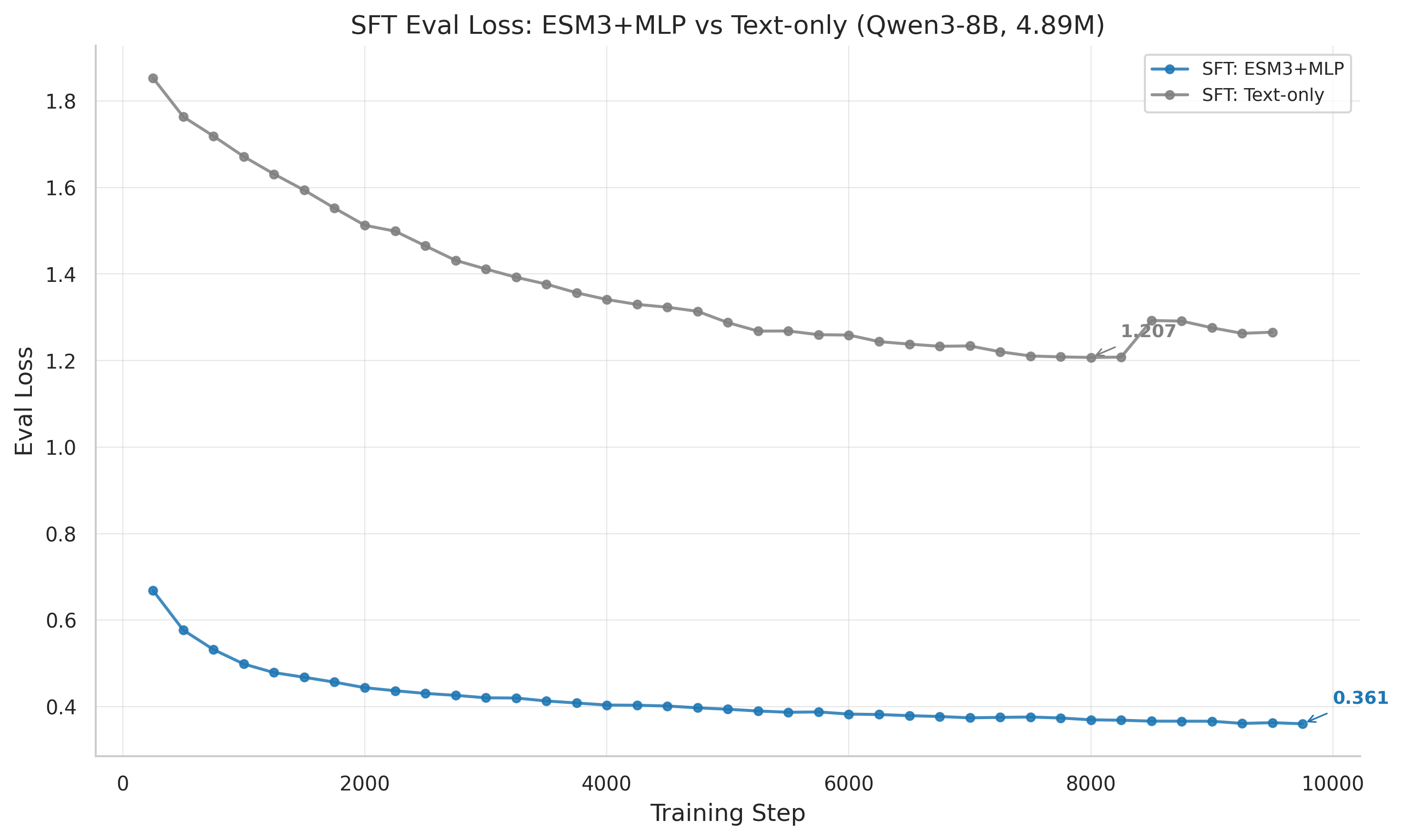
The MLP model converged smoothly with no overfitting, while text-only showed degradation after step 8000. ESM-3’s structural embeddings give a massive SFT advantage. The natural expectation: this advantage should carry over to reinforcement learning. Right?
From Imitation to Reasoning: Enter GRPO
SFT teaches the model to produce outputs that look like the training data. But can we go further? Can we teach the model to reason about protein structure using reinforcement learning?
Group Relative Policy Optimization (GRPO) is our RL method of choice. For each prompt, the model generates a group of completions (typically 8 or 16). A reward function scores each completion, and the model updates toward the better-rewarded outputs using a policy gradient. The key innovation of GRPO over PPO-based RLHF is that rewards are normalized within each group, producing relative advantages rather than absolute scores.
For the structure quality task, we designed a multi-component reward function that evaluates the model’s ability to assess protein structural quality:
- Quality alignment (weight 0.4): Does the model correctly categorize structural quality based on the ESMFold-computed pLDDT score?
- Numerical accuracy (weight 0.3): How close is the model’s predicted pLDDT to the actual value?
- Category match (weight 0.3): Does the predicted quality category (high/medium/low/very low) match the ground truth?
- Format bonus (0.1): Does the output follow the expected JSON format?
The three main components sum to 1.0, with the format bonus additive on top (maximum possible reward: 1.1).
The training data consists of 5878 protein sequences (filtered from 10K by removing proteins longer than 512 amino acids). Each protein is folded by ESMFold to produce ground-truth structural quality metrics, and the model must learn to predict these metrics from the protein sequence.
We ran 13 GRPO experiments over three days, systematically testing different configurations: MLP vs text-only approaches, different training durations (3 to 10 epochs), frozen vs unfrozen multimodal parameters, focal reward weighting, and classification-based task reformulations.
The Reversal: Text Wins at RL
Then came the surprise. When we applied GRPO to both SFT checkpoints, the rankings completely inverted.
The text-only model, starting from its eval_loss=1.207 SFT checkpoint (the worse SFT model), rapidly learned to generate well-formatted, accurate structure quality assessments. Over training, its mean reward climbed to 0.832, with near-perfect format compliance (format bonus 0.099 out of 0.1) and remarkably well-calibrated pLDDT predictions (79.1 predicted vs 79.7 actual – within 1% of ground truth).
The MLP model, despite its dramatically superior SFT performance (eval_loss 0.361), showed lower reward in its initial GRPO configuration: 0.582 mean reward, with format compliance stuck at 65% and systematically underestimating pLDDT (67.9 predicted vs 79.7 actual – off by 15%). A separate MLP run with different hyperparameters reached 0.780, narrowing the gap — but the text-only model still led, and the gradient analysis below explains why.
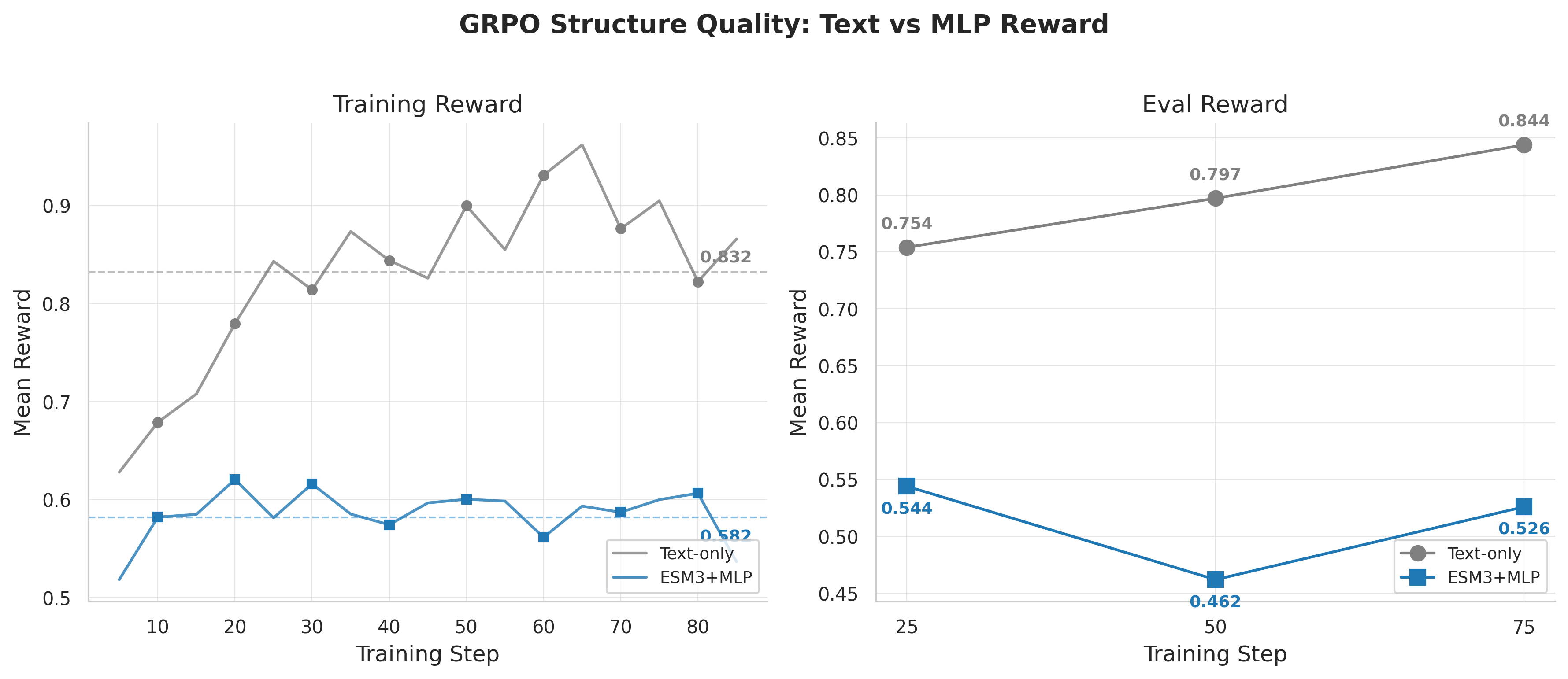
Let me emphasize how counterintuitive this is. The model with better SFT performance (as measured by eval_loss) is worse at learning through RL. The model with cruder protein representations (raw text tokens) learns faster and reaches higher reward.
Diagnosing the Problem: Follow the Gradients
To understand why, I looked at the gradient norms. In training, gradient norms tell you which parameters are actually receiving learning signal. If a parameter group has zero gradient, it is not learning – regardless of how much compute you spend.
The gradient norms told a striking story:
| Model / Task | LoRA Gradients | Multimodal Gradients |
|---|---|---|
| MLP, Structure GRPO | ~0 (frozen out) | 0.247 |
| MLP, ProteinLM GRPO | 0.826 | 0.0 (frozen out) |
| Text-only, Structure GRPO | 0.476-0.493 | N/A |
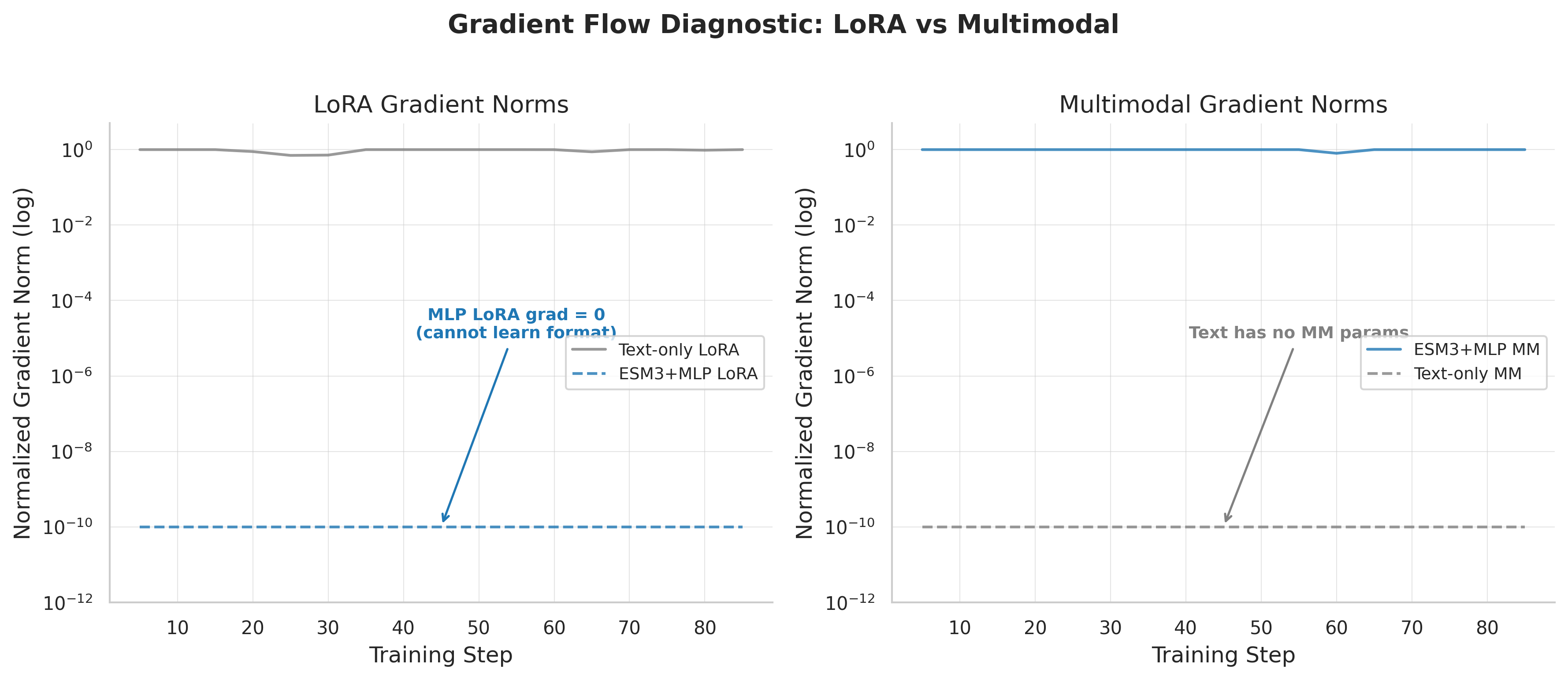
I call this the gradient routing problem: in the multimodal model, gradients flow predominantly to one subsystem during GRPO, largely starving the other. In the two tasks we tested, the “winner” appeared to depend on the reward function and task characteristics, with the result that one parameter group received negligible gradient signal.
This is notably different from SFT. During supervised fine-tuning, the next-token prediction loss provides a dense, per-token gradient signal that flows through the entire computational graph. Both the projector and LoRA adapters receive meaningful gradients because every token prediction depends on both the protein embeddings (flowing through the projector) and the language modeling capability (captured by LoRA). The loss is computed on hundreds of tokens per example, providing rich gradient information. A typical SFT example computes loss on ~200 output tokens; GRPO reduces this to a single scalar reward for the entire completion.
During GRPO, the signal is sparse. The reward is a single scalar computed on the entire completion. The policy gradient must propagate this scalar backward through the generation process, and somewhere in this chain, the signal becomes “winner-take-all.” The parameter group that provides the steepest local descent captures the gradient signal, leaving the other group in a flat region of the loss landscape.
The Fix (Partial): Freeze and Focus
If the gradient routing problem prevents simultaneous updates, what happens when we eliminate one pathway entirely?
We ran a “frozen-MM” experiment: freeze the multimodal projector completely and only update LoRA weights during GRPO. This forces all gradient signal through the LoRA pathway, removing the competition.
The results were encouraging:
| Configuration | Mean Reward | Format Bonus | LoRA Grad | MM Grad |
|---|---|---|---|---|
| Text-only (standard) | 0.832 | 0.099 | 0.476 | 0.0 |
| MLP best run (different hyperparams) | 0.780 | — | — | — |
| MLP frozen-MM | 0.774 | 0.095 | 0.071 | 0.0 |
| MLP frozen-MM + focal | 0.725 | 0.095 | 0.119 | 0.0 |
| MLP standard (gradient-starved) | 0.582 | 0.065 | ~0 | 0.247 |
Across all MLP configurations, the best reward was 0.780 (a run with different hyperparameters) and the frozen-MM fix reached 0.774. Both substantially outperform the gradient-starved standard run (0.582), confirming the gradient routing bottleneck. Format compliance jumped from 65% to 95%. This confirms that the gradient routing problem was the primary bottleneck: once LoRA can actually receive gradients, the MLP model learns effectively.
But text-only still outperforms at 0.832. The LoRA gradients in frozen-MM MLP (0.071-0.119) are noticeably smaller than text-only (0.476). Even with the projector frozen, its presence in the forward pass creates a partial information bottleneck. The LoRA adapters must learn through a compressed 32-token protein representation, while the text-only model’s LoRA can directly interact with every amino acid token in the sequence.
We also tried adding focal reward weighting, which upweights harder examples. This actually slightly hurt performance (0.725 vs 0.774 for frozen-MM alone), possibly because the focal weighting destabilizes the already-small LoRA gradients.
The Reward Breakdown: Component-Level Analysis
Breaking down the reward into components reveals exactly where each model excels and struggles.
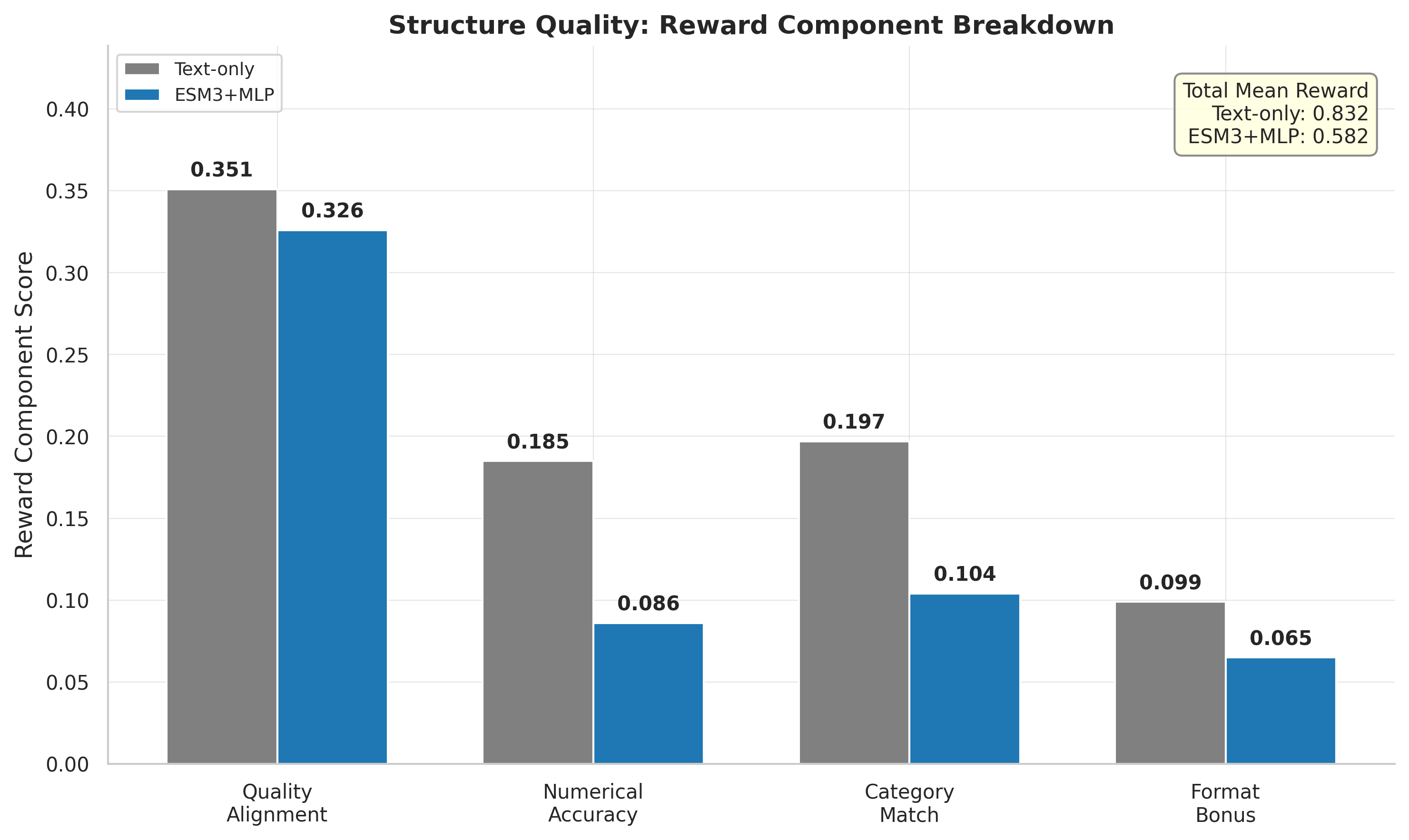
The text-only model outperforms across all four components. The biggest gaps are in numerical accuracy (text: 0.185, standard MLP: 0.086, frozen-MM MLP: 0.169) and category match (text: 0.197, standard MLP: 0.104, frozen-MM MLP: 0.164). Quality alignment is closer (text: 0.351, standard MLP: 0.326, frozen-MM MLP: 0.347).
One particularly revealing detail is pLDDT calibration. The actual mean pLDDT in the evaluation set is 79.7. The text-only model predicts 79.1 – remarkably close. The frozen-MM model overestimates at 85.1, while the standard MLP model underestimates at 67.9. This bidirectional miscalibration suggests that the projector embeddings contain strong pLDDT-relevant signal, but the GRPO training process fails to calibrate it properly. When the projector is frozen, its fixed embeddings anchor the LLM toward high-quality predictions; when unfrozen, the projector drifts in the absence of LoRA co-adaptation.
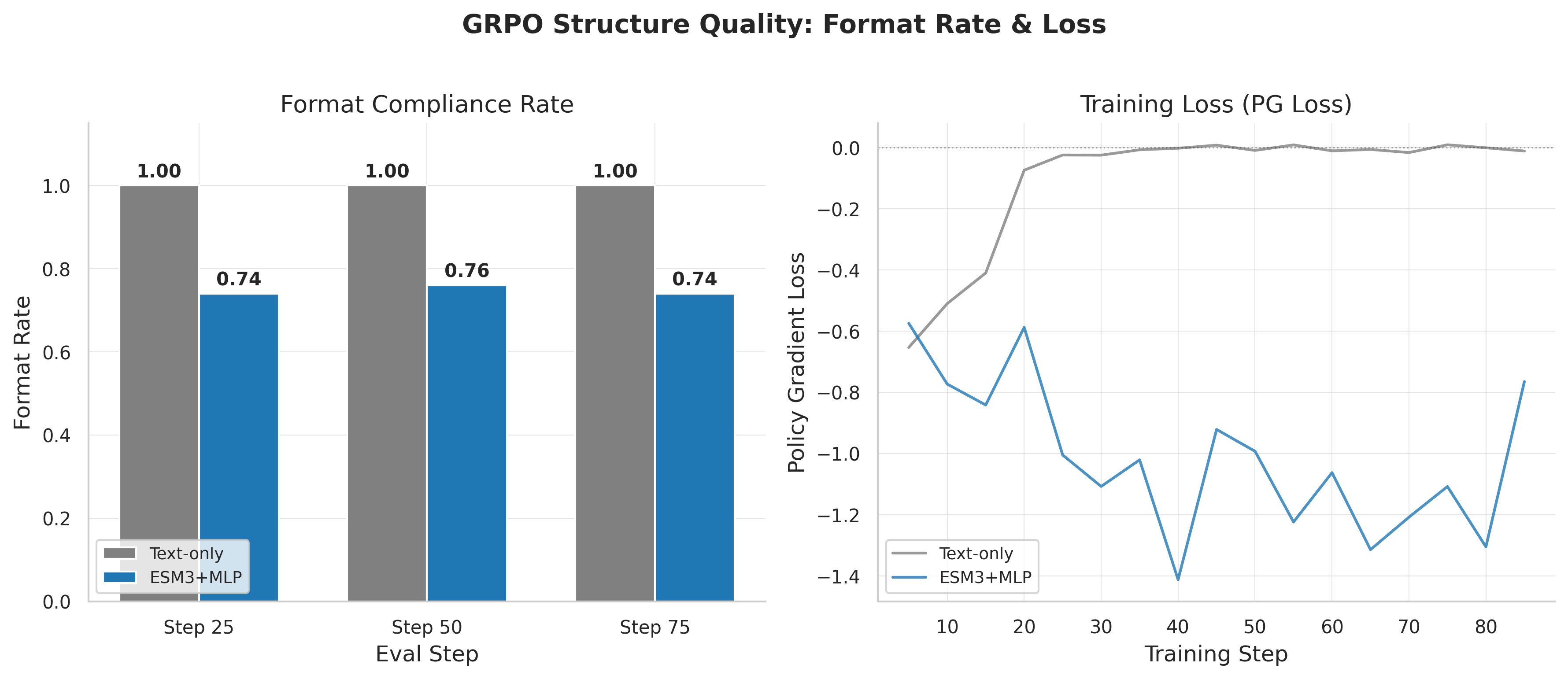
The format compliance story is particularly clear. The text-only model achieves essentially 100% format compliance from early in training. The standard MLP model stays stuck at 74-76%. The frozen-MM model recovers to ~95% compliance. Format compliance is entirely a function of LoRA learning – the LLM needs to learn the JSON output format – and when LoRA gradients are zero, format never improves.
The ProteinLM Benchmark: A Negative Result
We also tried GRPO on a second task: the ProteinLM benchmark, a curated set of 849 protein understanding questions with multiple-choice answers. The reward function scored the model on answer accuracy.
This was a clear negative result. Neither 3-epoch training (39 steps, final reward 0.695) nor 10-epoch training (130 steps, final reward 0.676) showed any reward improvement. The reward oscillated noisily around 0.68 throughout training with no discernible trend.
The root cause was different from structure quality but equally instructive. Here, 37-42% of groups had zero reward standard deviation, meaning the model generated nearly identical completions within each group. When all completions in a group are the same, the advantages are all zero, and no learning occurs. Nearly half the compute was wasted on groups that produced zero gradient signal.
Interestingly, the gradient routing was reversed compared to structure quality: LoRA received healthy gradients (mean 0.8) while multimodal gradients were exactly zero. The task’s small dataset (849 samples) and the high zero-std fraction suggest it simply does not provide enough diversity of training signal for GRPO to gain traction.
What This Might Mean for Multimodal RL
The gradient routing problem highlights an important difference between supervised and reinforcement learning in multimodal architectures — at least in the setting we tested.
In SFT, every token contributes to the loss, and the chain rule distributes gradients through both the projector and LoRA. The two parameter groups cooperate: the projector provides better protein representations, and LoRA learns to use them.
In GRPO, the reward is a single scalar for an entire completion. The policy gradient amplifies differences between better and worse completions, but this sparse signal appears to create competition between the two parameter groups. In our experiments, this produced a “winner-take-all” dynamic that resembles the gradient conflicts studied in multi-task learning (Sener & Koltun, 2018; Yu et al., 2020).
Scope caveat: We observed this pattern on two GRPO tasks (structure quality and ProteinLM benchmark) with one architecture (MLP projector). Whether this generalizes to other multimodal RL settings — different architectures (Perceiver, Flamingo), different reward functions, different encoder-LLM pairings — remains to be tested. Vision-language models like Flamingo and LLaVA have also required careful stage-wise training for RL, which is suggestive but not confirmation of the same mechanism.
What is Next
Three directions follow from these findings:
1. Two-stage GRPO. First train with frozen multimodal parameters to teach format compliance and basic reward structure through LoRA. Then unfreeze the projector for fine-grained structural learning. This sequences the gradient pathways rather than forcing them to compete. The frozen-MM results (0.774 reward) suggest this first stage could establish a strong foundation.
2. Gradient balancing. Explicitly balance the gradient norms between LoRA and multimodal parameters using methods like GradNorm (Chen et al., 2018) or PCGrad (Yu et al., 2020). The mutual exclusion we observe is exactly the kind of gradient conflict these methods were designed to address. We could also try simply scaling the multimodal learning rate relative to LoRA during GRPO.
3. The Perceiver pathway. Our Perceiver Resampler SFT failed to launch and remains untested. With 29.4M parameters (comparable to MLP’s 30.5M), the Perceiver uses cross-attention rather than concatenation to integrate protein information. This architectural difference may produce different gradient routing behavior during GRPO, potentially avoiding the winner-take-all dynamic.
The central paradox remains: our best SFT model (MLP, eval_loss 0.361) produces our worst GRPO learner (reward 0.582), while our weaker SFT model (text-only, eval_loss 1.207) produces our best GRPO learner (reward 0.832). This SFT-RL inversion — observed so far on the structure quality task — is a key challenge for the next phase of this project. If confirmed across more tasks and architectures, it could reveal something important about how multimodal systems learn from sparse reward signals.
This analysis covers 4 SFT and 13 GRPO experiments run between March 6-13, 2026, on 8x H100 GPUs. All models use Qwen3-8B-Instruct-2507 with LoRA (r=8). The combined SFT dataset contains 4.89M instruction-response pairs from six protein data sources. GRPO structure quality data contains 5878 training samples with ESMFold-based rewards. All loss values reported as eval_loss unless otherwise noted; training loss uses token_avg_loss (true per-token average, not HF Trainer’s running average). The 4.89M dataset was subsequently refined to 1.82M samples after discovering data leakage; re-evaluation on the curated dataset is planned.